
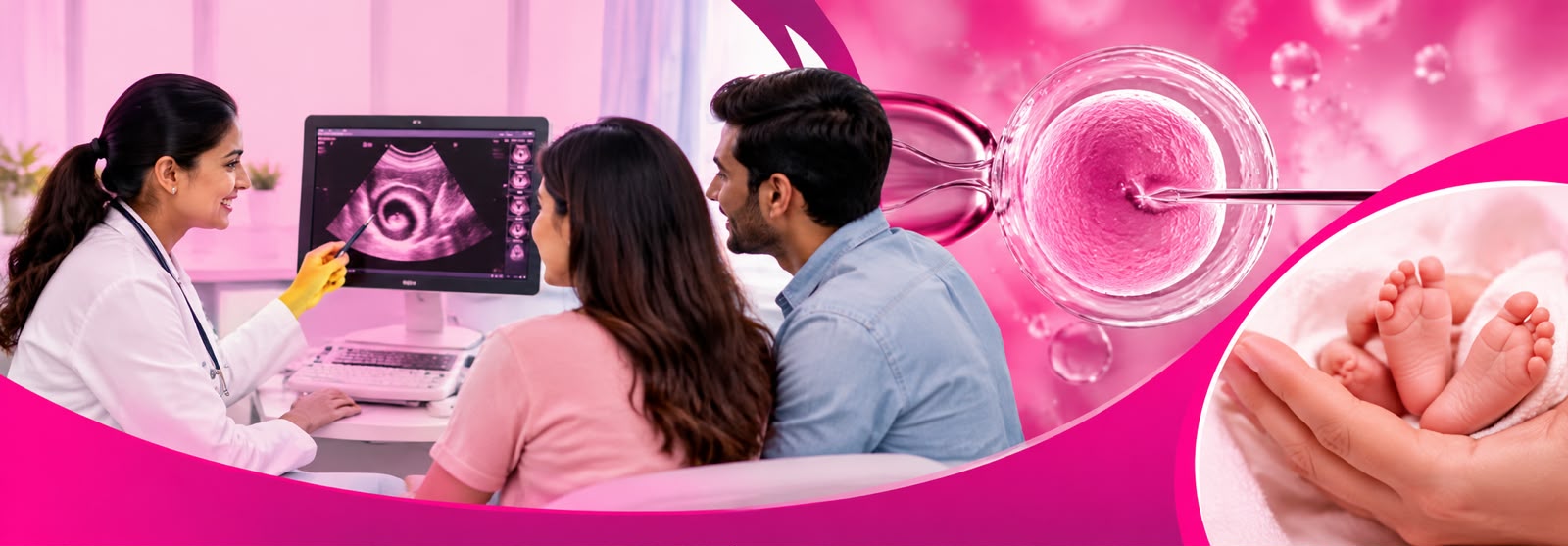
IVF is an assisted reproductive technology involving a sequence of clinical interventions resulting in pregnancy. It is an infertility treatment for couples who are not in a position to conceive naturally despite a period of one year of unsuccessful attempts. At Laimaa Fertility Clinic, beyond treating infertility, we also optimize IVF to prevent passing genetically driven conditions to children. In our embryology laboratory, we remove mature eggs from the ovaries and then fertilize them using collected sperm. Once fertilization is complete, the embryo is transferred to the uterus. Outcomes vary between patients and depend on factors including age, ovarian reserve, embryo quality and endometrial receptivity; your specialist will discuss what is realistic in your case.
Best IVF Treatment in Delhi — Understanding the Process
For couples looking for the best IVF treatment in Delhi, understanding how IVF works can help them conceive. Laimaa Fertility provides personalized IVF treatment based on various aspects like age, ovarian reserve, fertility diagnoses, medical history, and prior treatment results. IVF involves a number of carefully orchestrated phases, ranging from the stimulation of ovaries and retrieval of eggs through fertilization to embryo growth and the transfer of embryos. The treatment plan is individualized to each patient rather than using a one-size-fits-all approach. Fertility specialists and embryologists with years of experience collaborate to monitor progress and offer advice throughout the treatment process.
IVF Procedure Steps — What Happens at Each Stage
The IVF process typically involves the following steps:
- Ovarian Stimulation: Doctors may prescribe medications to stimulate the ovaries and encourage the development of multiple mature follicles.
- Monitoring: Ultrasound scans and blood tests monitor follicle growth and assess the body's response to treatment.
- Egg Retrieval: Once the follicles reach the appropriate stage of development, the mature eggs are retrieved through a planned medical procedure.
- Fertilization: The retrieved eggs are fertilized with sperm in the laboratory using conventional IVF or intracytoplasmic sperm injection (ICSI), when clinically recommended.
- Embryo Development: Embryologists monitor the fertilized eggs as they develop into embryos in the laboratory.
- Embryo Transfer: Embryologists may transfer a suitable embryo into the uterus at the appropriate stage. They may also freeze and store additional suitable embryos for future use.
Why Choose IVF Treatment?
IVF has been assisting millions of couples to become parents since its invention in 1978. The benefit of IVF is to have a successful pregnancy and a healthy baby. We at Laimaa Fertility Clinic offer the best IVF treatment in Delhi, with the latest clinical infrastructure, skilled fertility specialists, and advanced technologies.
Blocked tubes
When women face problems like blocked or damaged fallopian tubes, it becomes a major concern for natural conception. As natural fertilization is not possible, in our clinic, our fertility experts bypass the tubes and perform complete laboratory fertilization to improve the chances of conception using your own eggs.
Older patients
Women always have a biological threshold of conception. As women age, the quality of their eggs diminishes, prompting us to prioritise maximising the available opportunities. In the case of IVF, the probability of pregnancy is the highest at this point. Therefore, our fertility specialists at Laimaa Fertility Clinic offer customized IVF treatment plans to older women and those with low ovarian reserve. We typically recommend natural IVF aligned to your reproductive health to prioritize quality and improve outcomes even with fewer eggs available.
Male infertility
We also address male infertility with advanced IVF techniques. If your sperm quality is low or if you are facing retrograde ejaculation, natural conception becomes difficult. Therefore, with intracytoplasmic sperm injection (ICSI), our embryologists collect sperm accurately for successful IVF fertilization.
Unexplained fertility
Although it occurs in rare cases, sometimes even after multiple tests, it is not possible to diagnose the kind of fertility problem that patients are going through. In such cases, we recommend IVF either with their own eggs, their own sperm, or a donor to achieve a successful pregnancy.
PCOS
Women with polycystic ovarian syndrome have a higher chance of not getting pregnant naturally. As PCOS is responsible for causing hormonal imbalance and irregular ovulation cycles, IVF works effectively by allowing controlled ovulation and fertilization. Therefore, in this condition, we tend to enhance the chances of pregnancy with IVF.
Endometriosis
In endometriosis, tubal blockage occurs, the pelvic region gets inflamed, and cysts are formed in the ovaries, destroying ovarian tissues and reducing ovarian reserve. So, natural conception becomes difficult. Our fertility specialists suggest IVF to bypass fallopian tube blockages, improve egg quality, and prevent inflammation-related implantation failures.
Premature ovarian failure
In this case, patients within the age bracket of 30 to 35, whose ovarian reserve should have been normal, face unexpected loss of follicular function. In such situations, natural egg production becomes limited or absent, so we opt for donor egg IVF options with a consistently high success rate.
Cryopreservation
Beyond continuous live IVF cycles, we also provide embryo cryopreservation. With this technique, we help patients freeze and store embryos for future IVF cycles or to get pregnant in a later period when their natural ovarian reserve may dry up. They, as a couple, are hence able to delay pregnancy as per their discretion, and this flexibility supports both personal and medical decisions.
Preventing genetic disorders
One of the core reasons we practice IVF at Laimaa Fertility Clinic is to prevent the transmission of genetically driven conditions through advanced testing. With pre-implantation genetic testing to screen embryos, we detect chromosomal abnormalities, and based on the results, we select healthy embryos for transfer. Where pre-implantation genetic testing is clinically indicated, it can reduce the likelihood of transferring an embryo carrying a detectable chromosomal abnormality. It does not eliminate all genetic risk and is not recommended for every patient.
Control over timing
At Laimaa Fertility Clinic, our team of gynecologists, fertility specialists, and embryologists provides better control over pregnancy timing, which is not similar to natural conception. We allow couples to choose what is convenient for them in terms of treatment and align with individual and professional commitments, so that the journey becomes much more predictable and manageable.
How to Prepare for IVF Treatment?
Couples undergoing IVF are advised by our fertility specialists to prepare physically 3 months before to achieve a healthy sperm production process and complete egg fertilization potential. Here are some suggestions to increase your chances of getting a successful IVF pregnancy.
Nourishing foods for healthy eggs and uterus
For nurturing eggs, the uterus, accelerating ovulation, nourishing the womb, and preventing egg degeneration, nutritious foods are important. So, to boost the IVF success rate, we plan a specific diet chart for women, including green leafy vegetables, whole grains, berries, eggs, milk, tomatoes, bananas, and other proteinaceous foods.
Effective foods for motile sperms
Not only for women, but nourishing foods are also important for male partners for healthy sperm production. A healthy diet increases the motility rate, vigor, and volume of the sperm. Hence, we recommend consumption of pumpkin seeds, walnuts, tomatoes, bananas, pomegranate, berries, oysters, and beef.
Regular exercise and weight control
Obesity or low BMI is a restricting factor for successful IVF. To have a healthy pregnancy, we suggest having a normal BMI of 18.5 to 24.9. The other thing we advise doing before undergoing IVF is to take daily walks and yoga.
Reducing caffeine consumption and avoiding addiction
We advise limiting caffeine to no more than 200 mg per day (roughly one to two cups of coffee) in the months before and during treatment; higher intakes have been associated with reduced treatment success.
Taking folic acid and Vitamin D supplements
Folic acid is an essential nutrient, and we advise having it 3 months before IVF and also during pregnancy. Folic acid helps in improving embryonic health and preventing brain damage and irregularities in the fetal spine, increasing the overall IVF success rate. Similarly, vitamin D is also important as it can help prospective mothers have a successful pregnancy.
Refraining from sexual intercourse before sperm collection
We strictly advise the male partner in IVF to refrain from sexual intercourse, masturbation, or ejaculation at least 3 to 4 days before the collection of the sperm. This will help retrieve a sufficient volume of semen for the selection of robust and high-quality sperm.
IVF Treatment Procedure: Step-by-Step Process
The IVF process in Delhi typically involves multiple appointments, follow-up consultations, and monitoring visits, with the exact schedule depending on the treatment plan. With proper and well-observed procedures for optimizing success and safety, our fertility experts provide the best IVF treatment in India.
Step 1: Ovarian stimulation
Our fertility experts begin with ovarian stimulation using fertility drugs to enhance ovarian reserve and generate additional eggs after a thorough consultation. We regularly check the progress during this phase using ultrasound and also perform blood tests to monitor the level of hormones.
Step 2: Egg retrieval
Next, we extract eggs using a minimally invasive surgical procedure called follicular aspiration or egg retrieval, where we provide mild sedation so that the patients do not feel any pain. Using ultrasound, we insert a fine needle into the ovaries and carefully pick out the eggs contained in each mature follicle. In case the patient cannot generate eggs, we seek alternative solutions, such as donor eggs.
Step 3: Insemination and fertilization
On the day of egg retrieval, a semen sample is collected and prepared in the laboratory, where the most motile, morphologically normal sperm are isolated by density-gradient centrifugation. In conventional IVF the prepared sperm are then co-incubated with the eggs; where male-factor infertility is present, we use ICSI instead and inject a single selected sperm directly into each mature egg.
Step 4: Embryo culture
After the development of fertilized eggs into embryos, we monitor the growth and cell division carefully. After 5 days of the blastocyst stage, we perform pre-implantation genetic testing before embryo transfer to detect any genetic conditions. After that, we identify healthy embryos for final transfer.
Step 5: Embryo transfer
The selected healthy embryos are implanted into the uterus after 3 to 5 days of IVF fertilization under a comfortable clinical atmosphere. Our embryologists insert the embryo into the womb of the mother using a fine catheter. It is a quick process without the requirement of anesthesia. We also suggest freezing the remaining healthy embryos for future use.
Step 6: Pregnancy test and follow-ups
We confirm the pregnancy by running a blood test after 14 days of embryo transfer. If the treatment becomes successful, we recommend follow-up sessions throughout the pregnancy journey. However, in some cases, when the first IVF cycle fails, we encourage patients to come for the next cycle with a modified IVF protocol.
Patients should anticipate regular communication with the fertility specialists throughout the process. Treatment length can vary depending on the individual's response, treatment protocols, and whether the embryo is frozen or fresh transfer is scheduled.
IVF Treatment Journey: Your Path to Parenthood
Our team of fertility experts, gynecologists, and embryologists guides you through every stage of the IVF treatment with utmost care and compassion. We consult in private and map out an individualized IVF treatment plan for every couple. Every process is monitored closely using advanced techniques so that the success rate can be improved. As a result, our patients feel confident and informed at every stage. We ensure accuracy from consultation to embryo transfer for achieving a successful and healthy pregnancy.
IVF Treatment in South Delhi — frequently asked questions
The number of visits required during an IVF cycle varies depending on the treatment plan and the individual's response to medication. Most monitoring appointments are scheduled after ovarian stimulation begins to track follicle development and hormone levels. The fertility specialist will determine the exact number and timing of appointments based on the patient's treatment needs.
The duration of an IVF treatment course varies by patient and depends on the treatment plan. Your fertility specialist will provide an individualized schedule after reviewing your medical history, fertility assessment, and treatment needs.
Not always. Depending on your clinical circumstances, we may plan the transfer as part of the same cycle or as a frozen embryo transfer at a later date.
IVF cost varies from patient to patient, depending on the treatment protocol, medications required, number of cycles, and any additional procedures such as ICSI or pre-implantation genetic testing. At Laimaa Fertility, we provide a personalized cost estimate after your initial consultation and diagnostic workup, so you know exactly what is included before starting treatment.
A self-cycle (or "own cycle") IVF uses the patient's own eggs, and the partner's sperm where applicable, rather than donor eggs or sperm. It is typically recommended when ovarian reserve and egg quality are sufficient for the treatment plan. Your fertility specialist will confirm whether you are a suitable candidate after a full evaluation.
Talk to a fertility specialist about IVF Treatment in South Delhi
Every plan starts with a diagnosis, not a package.