
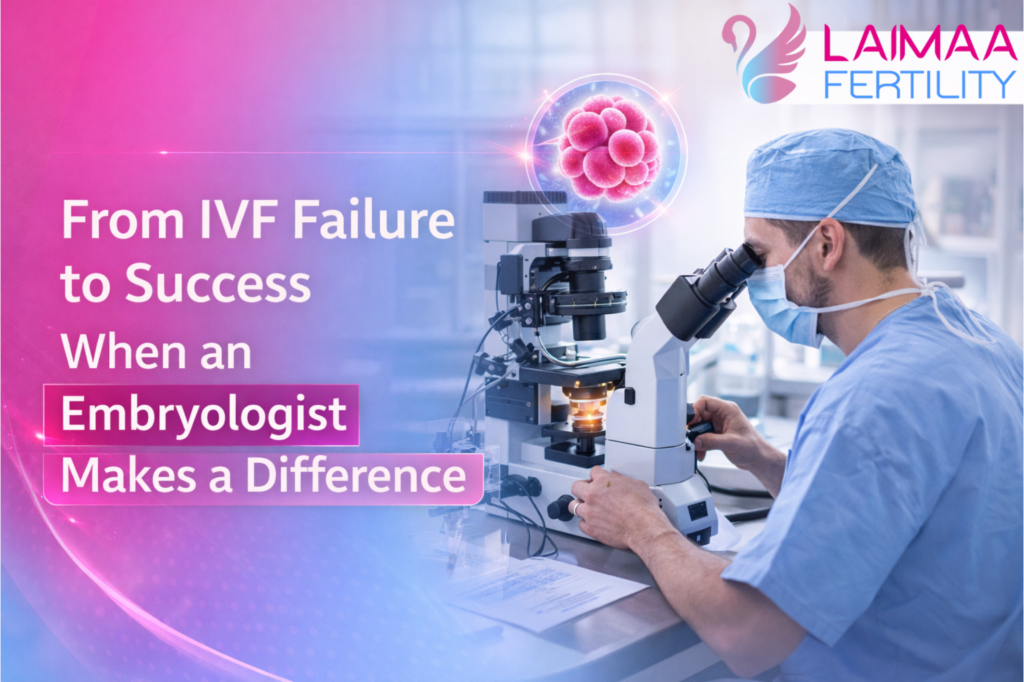
In most in vitro fertilisation (IVF) conversations, the doctor becomes the centre of attention. Patients remember the consultation room, the ultrasound screen, the trigger date, and the result call. Very rarely, they remember the laboratory. Even more rarely, they remember the person who spends six to eight hours with their embryos, often longer than anyone else involved in the treatment.
Yet, when IVF fails again and again, the reason is very often not in the consultation room. It is hidden in a series of very small, silent choices made inside the lab. These choices are not dramatic. They do not look like mistakes. They look like routine.
This is where the embryologist quietly changes the story.
IVF was first made possible through the work of Robert G. Edwards, but what most people forget is that his real contribution was not a machine or a drug. It was laboratory thinking. Modern IVF is still, in many ways, a laboratory discipline more than a clinical one.
And yet, we still talk about IVF failure almost entirely in clinical language: hormones, age, ovarian reserve, uterus, and endometrium.
Very little is said about how the embryo was handled, observed, disturbed, classified, protected, or quietly compromised.
This blog is not about laboratory equipment, incubators, or technology trends. It is about the human being who operates between biology and uncertainty — the embryologist — and how IVF success sometimes depends less on what is done, and more on what is deliberately not done.
IVF Does Not Fail Suddenly – It Fails Slowly
Most failed IVF cycles do not collapse at one big point. They weaken gradually.
An embryo does not usually stop developing because of one dramatic event. It slows down because of accumulated stress. Stress in the lab does not look like stress to patients. It looks like:
- A slightly longer exposure to room air
- An extra minute under the microscope light
- Repeated checking
- Unnecessary movement
- Over-handling because someone wants reassurance
None of these is a mistake on its own. But embryos respond to accumulation, not to individual events. A skilled embryologist thinks in cumulative damage. This is one of the biggest gaps between an average and an exceptional laboratory professional.
The best embryologists are not the most active ones. They are the most restrained ones.
Laboratory Confidence Is Not Technical Confidence
Many clinics advertise highly advanced labs—very few talk about laboratory judgment.
A technician can be trained to perform Intracytoplasmic Sperm Injection (ICSI). A professional embryologist develops a sense of biological timing.
There is a difference.
- The timing of denudation.
- The timing of the injection.
- The timing of embryo assessment.
- The timing of vitrification.
These are not clock-based activities. They are embryo-based activities. An embryologist who follows the schedule rigidly may technically do everything correctly and still lose outcomes.
An embryologist who learns to adjust workflow around the behaviour of each cohort of oocytes and embryos is practising a different level of laboratory care. This flexibility is not visible in brochures. It is visible only in consistent pregnancy rates in difficult cases.
IVF Failure After “Good Quality Embryos” Is Often A Lab Communication Problem
Patients are frequently told: “You had good embryos.” This sentence hides a serious limitation.
What does “good” mean? Grade. Cell number. Fragmentation. Blastocyst expansion. These parameters describe appearance. They do not describe stability. An embryo that looks excellent can still be metabolically fragile.
In many laboratories, the communication between embryologist and clinician is structured around static scoring.
But IVF outcomes improve when embryologists communicate something else: behaviour.
- Was cleavage synchronous?
- Was compaction smooth or irregular?
- Did blastulation happen abruptly or progressively?
- Did re-expansion after biopsy or thaw happen confidently or sluggishly?
These behavioural patterns are extremely predictive, but they are rarely included in reports.
When an embryologist starts reporting biological behaviour rather than visual grades, clinical decisions change.
Transfer strategy changes. Freeze strategy changes. The number of embryos transferred changes. And success rates quietly improve.
One Of The Biggest Laboratory Risks Is Emotional Pressure
Embryologists work very closely with patient emotions, but patients rarely see them.
The calls. The messages. The waiting couples. The visible anxiety. In repeated failure cases, pressure inside the lab increases.
There is a subtle and dangerous shift that can occur: The embryologist begins trying to rescue outcomes. More manipulation. More “fine-tuning”. More checking. More repositioning. More intervention. This comes from empathy, not carelessness. But biology does not reward emotional urgency.
A mature embryologist learns—how to protect embryos from human anxiety.
This emotional discipline is rarely discussed, but it is one of the reasons some professionals consistently perform better in complex cycles.
Also read: Genetic Testing in IVF | PGS & PGD
IVF Failure Is Sometimes A Data Problem, Not A Biology Problem
Most laboratories collect large volumes of data. Very few actually analyse it meaningfully.
A good embryologist reviews:
- Fertilisation failure patterns by stimulation protocol
- Abnormal fertilisation trends by sperm source
- Blastulation drop-off by day of insemination
- Freeze survival by the operator
- Biopsy recovery rates by timing
This is not administrative work. This is biological auditing.
When embryologists lead internal outcome analysis rather than leaving it entirely to clinical teams, very small workflow changes produce measurable improvement.
IVF success is rarely created by a dramatic change. It is created by small corrections made repeatedly.
Why Do Embryologists Make The Biggest Difference In Difficult Cases
Easy cases succeed almost anywhere. Young patients. High oocyte yield. Good sperm. Predictable response.
In such cycles, even average laboratory practice may achieve good results. The real value of a highly skilled embryologist appears in difficult biology:
- Low oocyte numbers
- Poor fertilisation history
- Repeated blastulation failure
- Severe male factor
- Post-cancer fertility preservation
- Advanced maternal age cycles
In these cases, each oocyte carries disproportionate emotional and clinical value. Handling becomes more careful. Timing becomes more individualised. Selection becomes more behaviour-driven. This is where professional maturity shows.
Final Thoughts
IVF marketing often focuses on machines, numbers and promises. Real improvement happens quietly. It happens when an embryologist pauses before intervening. It happens when an embryo is left undisturbed for one more hour. It happens when a fragile blastocyst is not pushed into transfer simply to meet expectations. It happens when laboratory teams review failures without blame.
From failure to success, the turning point is very often not a new protocol. It is a different way of thinking inside the lab. And that way of thinking belongs, more than anyone else, to the embryologist. At Laimaa Healthcare, this laboratory mindset plays a central role in how IVF cycles are reviewed, refined, and improved for patients who have experienced previous failures.